Showing posts with label lazy. Show all posts

Monday, August 13, 2012

Parents

Hello Reader!  Since I'm writing about teenagers, and I am currently wading my way through those awkward years between adolescence and adulthood where everyone expects me to know what I'm doing as if I'm an adult and then laughs at me when I talk about what I want to do as if I'm a teenager, I figured it would be a great idea to talk about one of the central issues that come up in YA fiction: parents.  And our relationships with them.

With that name, how do you think his momma treated him?

YA fiction either puts the parents and adults in the backseat as buffoons, untouchable gods, or condescending asshats.  The teenagers at the center of the story either rebel, or rebel, or rebel against these authority figures because...well, what else do teenagers do but complain, break the law and cry about their crush not giving them a Valentine's Day Gram.  To put it lightly, this is all very cliche and awfully silly.

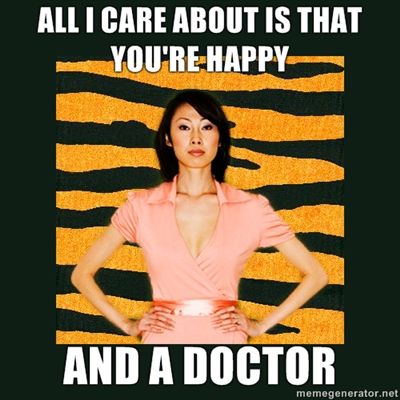
Going to school with a ludicrous variety of kids, I've seen the gamut of parenting styles.  You've got the uber hippies who sneak pot for their children, and you've got the Asian tiger-moms who stuff napkins into their purses every time they visit a restaurant.  You've got super successful kids who never once in their life did anything wrong or got yelled at or got into trouble with teachers, either because they were sheltered beyond belief - or they were simply just good, motivated, hard-working kids.  On the other hand, there are kids who are constantly in trouble with their parents, butting heads and getting into conflict, taking their frustrations out on their bodies with vengeful tattoos and awkward piercings, yet still get better grades than you ever will and are wildly successful.

OMG I hated the Muslim guy's arc...why do we always have to impregnate someone to be "relatable"???

When did Degrassi ever address those kids?  Stereotypes are really easy to write about.  Could be because the majority of the characterization work is already done for you, but it's also because authors are in a naturally lazy profession.  You're sitting at home, either with pen & paper or on a laptop, writing down words and stringing together paragraphs into a story.  There's no heavy lifting involved unless you're fond of using absurdly giant pencils, there's no sweating from back-breaking manual labor unless you enjoy moving around reams and reams of scratch paper, and there's certainly very little dirty work involved unless you have a penchant for ripping apart your felt tip pens and pouring the ink all over your face every time writer's block comes knocking.

No, that's still not right.  Stereotypes sell.  Yes, that's better.  When you read interviews with agents and publishers, they want the next new thing.  To better handle the uncertainty of the public's fickle tastes, they want what's already worked beforehand.  This is completely understandable.  It's also lulled writers into complacency.  Especially when it comes to parent-teenager relationships.

I really need to learn how to put .gifs on here...

I don't blame any one television show or novel *cough* Degrassi *cough* *cough*.  I blame authors who can't think of new ways to get things done.  I'm not saying I'm some writing messiah with a innovative writing style that will blow people away - although if someone ever says that about me I'll grin so wide you can see my wisdom teeth.  All I'm saying is that I'm noticing a problem, and when I walk through Barnes & Noble I don't see anyone trying to fix it.

All you ever see are bumbling buffoons of parents.  Honestly, the best parent-kid relationships I've seen in YA fiction are in Harry Potter.  Everyone rags on J.K. Rowling for not being a literary genius, and yes her writing isn't top notch Charles Dickens fare.  But her relationships, the characters' interactions with each other, these are miraculous.  With very little literary prowess, she manages to blow us away with real feelings and emotions and everything in between those two synonyms.  The relationship between Ron and his mother is fraught with overbearing love and wisdom oft-ignored.  Molly Weasley is not a bumbling fool, but neither is Ron a brazen idiot.  Dumbledore is basically Harry's grandpa, and he's always looked to as a source of wisdom and confidence - he is not an authority figure to brush up against rudely and without any motivation other than to move the plot along.

TOO SOON!  TOO SOON!  *sobs in the corner*

You'd expect YA fiction to take a page from the wildly successful J.K. Rowling and her awesome character relationships.  Instead, they decide to settle on this general, very narrow tidbit of wisdom: there will never be another Harry Potter so why try?  They'd much rather go for the small game like the Hunger Games (Lord almighty why does Katniss' mom suck that bad?) or Twilight (Bella's dad is like a teenage boy who decided that having a mustache makes him a man).  These relationships suck, and the parents exist as filler - they had to pop out of something right?  Disney really knows what's up though.  They avoid all of these problems altogether and just kill the parents right from the get-go.  Brilliant people, Disney.  Just brilliant.

But then again, what do I know?  I'm no best-seller.  Here's an excerpt between Sheba, Briok's mom, and her son.  This takes place at the grave of Briok's father.  It's the first time he's visiting it, since he was in a coma when his father was officially buried.  His mother takes him, and tries to console him after he learns that he is half-human and the last Magna Beast.
              After several minutes without moving Sheba took pulled Briok away and looked him in the eyes.  “Do you know why I think you can handle this?”  She smiled and turned to rest her back against the statue.  “Proteus told me what you did, that night.  At that cafĂ©, when you decided to disobey me and your father.”  She pulled him close to her.  “Briok, you jumped in front of a bullet.  You didn’t know that you were the Magna Beast, you didn’t know that you would probably heal.”  Briok continued to look away from her, but signs of life began to show.  He was fiddling with the grass, pulling at it in tufts.
            “I wasn’t thinking when I did it,” he finally spoke.  “And you’re my mom, you’re supposed to believe in me.”  He pulled his head up, “You're supposed to say all these great things about how amazing I am and support me.”  
             “Briok, you know your mother,” she stopped his hands from pulling at the grass, 
“If you do something wrong, I’m not afraid to tell you.  If you weren’t so wonderful, I 
would tell you.”  She laughed, “You risked your life.  You should be proud.  More than 
that, Briok you proved that you’re a man.  I’m proud to have you as my son.  You don’t 
listen to me, but I’m still proud.”  She hugged him.  Despite his dour mood, he returned her  
hug, burying his head in her shoulder

Like always, let me know what you think.  Until next time then.

Saturday, January 28, 2012

Hierarchy of Race

Hello Reader!  The title of the blog post sounds like something you'd see from my other blog right?  And you know, it probably would be a good topic to discuss there too.  But for now, I feel like it's super relevant to the "legend of a work in progress".  It's probably one of the most important considerations I made in creating my characters and shaping the species (be it Human or alien) they come from.

It's stupid how gorgeous he is, right?

In case you don't know what the Hierarchy of Race is, here's a link to Professor Michael Hunt's paper.  He teaches at the University of North Carolina, Chapel Hill and has written a book about how racial ideologies have shaped US foreign policy.  To sum up what he says though, there's a very real race hierarchy in people's minds that informs them in their day-to-day interactions.  This guy is black, thus he is less than an asian, who is less than a white.  And so on and so forth.  While this may not be true for everyone, and I would argue that for the majority of people it is not true, it's apparently a really big part of US foreign policy and you can't deny the fact that it's a huge part of the American legacy.

And it's also a huge part of science fiction and fantasy.  Look back on a lot of the classics in either genre.  You'll see a definite partitioning of races based solely on the fact that they are who they are.  Yes, in Lord of the Rings the Quenya fought a war with the Noldorin and they certainly don't shy away from marrying into the race of humans.  And in science fiction once in a while you see aliens turning on each other politically like Estraven's struggle against his native Karhide in Ursula K. Le Guin's Left Hand of Darkness.  But the vast majority of science fiction and fantasy (syfy) novels have a set number, kind, and relationship for the races that populate their books and authors do not deviate from these set standards.  Orcs are always stupid, trolls are even worse, and elves are badass gorgeous people.  Humanity is either in charge of a system of worlds and corrupted, or fighting against an organized system of worlds and pure.

Poor kid...

Sure, you can hide behind the idea that these are tropes, motifs, structures that have worked before and can totally work again.  I agree that they're fun, but I also posit that they are outdated.  I'm tired of reading about the same old relationships, I'm tired of reading about the human protagonist saving the aliens because their weirdo ways saved him/her, I'm really freaking tired of reading about the same political, societal relationships between the perennially creepy species and the always beautiful ones.  It's kind of ridiculous how stagnant things have become.

Syfy was meant to be a world of endless possibilities, where the problems and issues of the real world can be explored and extrapolated on a dramatic scale.  Interesting interpretations should abound, not ossified hierarchies that don't even exist.  Why can't the Elves be hoodlums and the Orcs be the dignified ones?  Where does it say that every future society has to be a dystopia ruled by despotic aliens/humans?  Everything is the same same same.  Ugh.

Funny face, lulz

Why is it that after a war between aliens and humans, the political and societal effects aren't explored?  Don't you think that aliens would intermingle with humans?  That humans would influence aliens, that after millennia some of them might even adopt our religious systems?  Why is it a fact that the religions of today die out in the future?  After two millennia we still have Christianity, what's another two?  Often I feel that the attachment to these tropes, especially concerning how aliens or fantasy races are developed and interact with each other, is built off of laziness.

Laziness, however, is a lazy answer.  More probable is the idea that the whole genre of syfy is losing its focus.  People are beleaguered with spectacle and awe, an empty miracle of technology that will only hold a person's eyes without ever touching their soul.  And the easiest way to deliver this spectacle is to not push the envelope, to leave the bells and whistles of syfy be.  There's no challenge for the audience, and none for the creative mind.

Such a badass, so good at world building

But it's a lot less fun.  Maybe, after all of this complaining, I should throw out there what I'd like to do with my races.  Maybe.  I find it to be self-serving, a "Gotcha!" moment that is rooted in arrogance.  I do not think that I have achieved whatever level of creativity is needed to abolish the old stereotypes.  I only ardently wish that the work I am doing now is seen in that light.  I want to shake things up, I want to break barriers.  The Howlas aren't a single, mindless race of beings.  There are Howlas who hate other Howlas, who are Christian and Jewish, who love humans and hate themselves.  Humanity is not weak but burdened, under the thumb of no alien species and in detente with all of them.  Argh, I'm digressing.

Either way, I think syfy needs to change.  Orcs shouldn't always be stupid and ugly, aliens shouldn't always be war-mongering.  It'd be nice if authors and filmmakers and showrunners could have some creativity, and even more so it would be nice if they respected the audience.  Until next time then.

Wednesday, December 22, 2010

You've Lost A Lot In These Waning Years

Hello Reader!  I was coursing back through time yesterday, staring my memories in the face.  As it were, I couldn't help but gloss over - alright I'm a liar, I didn't gloss over it, I outright pored over them - five years of my life spent with someone.

No, I wasn't in a relationship with the person.  Although, we were close enough for it.  And it's not appropriate to explain here why the friendship soured.  I feel it is enough to say that even the best of friendships have beneath them an undercurrent of...well, something far more sinister and darker than just friendship.

Is it really melodramatic for me to call it a betrayal?  I mean, for God's sake it's been three years since everything ended.  How am I still hung up on this issue?  Probably because I did many wrong, cruel things to that person in the dying shambles of the relationship.  My justification has been that worse, crueler things happened to me.  Not over the course of a year, but during that entire five year epoch of my tiny life.  That's good enough justification right?


Either way the issue is important, for this blog at least, because I want it in my book.  I think I've said somewhere that this novel is asking the question what if Paul Muad'dib had to go to high school and still lead the Fremen?  What if Harry Potter and Dune were to be mashed up, their storylines and character attitudes merged together?  But in a lot of ways, the teenage relationships between Harry and his friends are incredibly juvenile.  For one thing they don't curse.  Maybe British children are less foul-mouthed than American children, but seeing as how I'm an American I can't really avoid writing about what I know.

That's a minor thing though.  What irks me as I reread the Harry Potter series is the genuine goodness in each of the children.  It seems to be that all of the undesirable traits, or at least those that people absolutely everywhere absolutely cannot tolerate, are sequestered to Slytherin house.  For pity's sake, the worst thing anyone in any of the other houses ever does is uncleverly tease Harry.  Most of them, actually all of them, apologize to him after they've been proven wrong by our persevering hero.  Of course I understand that the novels are meant for children.  Why shove complexity down their throats?  Ravenclaw can have terrible human beings in it too?  Whoa, heavy man.  To be fair there's already enough new information, and the whole damn thing is presented so delightfully and with so much vivid and wondrous detail there's no reason for any more complexity in the relationships between these children.


But then again maybe there is.  High school isn't the sordid affair presented by many books, movies, television shows etc.  Often these media present to us a wasteland of common sense inhabited by cliques who are all mutually exclusive from each other.  This is a complete fallacy.  High school, or at least what I experienced high school as, was an ever shifting chaotic mess of children figuring out who they are in often harmful ways - to themselves and to others.  I had friends who did more hard drugs in high school than many of my college friends, who pride themselves on their lack of boundaries, even attempt.  Backstabbing in college is so much easier, because you're not clustered with the same 60 students everywhere you go for six hours straight.  There isn't much harmful gossip in college, because as fast as word travels at the university it is thousands of magnitudes slower than the drivel that's tossed around on a high school campus.

Again, as always, I'm speaking in generalities.  You can bombard me all you want with examples of gossip and backbiting behaving by rules diametrically opposite to those I've outlined above.  Fine.  I'm a generalist, I apologize, I hope you can learn to accept it as I've learned to accept the nitpicking.  Also, I could be totally wrong.  If I am, I'll admit it.  Now on with it.

Now, how does this vision of high school relate to the novel?  Well, I'm writing about high school students for most of the story.  In fact, the first novel's plot is driven by the high school aspirations, pratfalls, missteps and melodrama that follow my teenage characters.  In a lot of ways, high school is the very first step - or series of giant leaps - we all take in becoming less innocent.  I'm not just talking about sex or drugs, I'm talking about sins and diseases of the heart.  Some of us become arrogant in our ephemeral youth, believing the success and grandeur of our teenage years will last us until we're well into the throes of our death bed.  Some wayward souls dive headfirst into waters unknown and do not surface.  Ever.


Tuesday, August 31, 2010

Franzen & Fantasy

Hello Reader!  I recently began reading Jonathan Franzen's The Corrections, a 2001 novel that has been called by numerous critics and readers "the best novel of the millenium's first decade".  Heavy stuff right?  Definitely.  The novel deals with consumer-driven America and a very broken, very dysfunctional family's attempt at having one last Christmas together.  It gives the reader a rather cruel, incredibly stark, and unapologetically brutal depiction of this family's faults and worries, each imperfection clearly outlined without the slightest hint of empathy.

Which doesn't make it bad.  In fact, Franzen's objectivity in writing is masterful.  Most other authors would feel the need to inject some sentimentality in order to lure the reader into a false sense of pity.  Not Franzen.  He relies only on his prose and the events of these characters' lives.  And his writing is absolutely brilliant.  Metaphors are created without relying on default images.  He uses a Nordstrom bag filled with old letters to describe an old woman's paranoia and frailty.  Details are thrown at the reader without hesitation, as if Franzen has a secret well full of them.  It's amazing how much the guy has made up in his own head so his story will work.

But I don't like the book.  I just can't wrap my head around it.  It's engaging, only because the writing is a river of discontent and malformed values that I can't help but follow.  The events of the novel I could do without.  I don't want to read about how a disgraced college professor fulfills his lust for a former student by masturbating on his comfy leather chaise, and in the next few paragraphs learn that that college professor's Parkinson's-rattled father is sitting on the same leather chaise eating hors d'oeuvre.

It's level of detail is disgustingly magnified and, in a way, kind of arrogant.  The entire writing style reminds me of a bemused parent watching over a struggling child, one of those kids who valiantly attempts to stuff the triangle piece in the circle hole.  Franzen has stated before that the entire novel was a memorialization of the Midwest...but is that from the perspective of a guy who was educated at Swarthmore and lives on the Upper East Side of New York?

His apparent arrogance aside, I think I'm just biased against books like this.  There isn't really a redeeming factor about any of these characters.  Even the father, who has dementia, is given the same brutal treatment.  And while that does say something about the American character, I need heroes in my novels.  Therein lies my beef with literary fiction.

The subset of fiction has, in my ill-educated opinion, become a medium of retreat for the incredibly well-educated authors of America.  For no better reason than "they can" are their books esoteric in nature and highly specialized for a specific group of people: those who have enough time in the day to read. These people don't have to work nine hour days then return to a hectic home where they must clean the house, their kids, make dinner or buy it, and then attempt to catch up on the extra work they've accumulated because they couldn't get it done at the office two hours away, three with traffic.

No, the people that avidly read Franzen, or Foer or Chabon, come back from work with their house sparkling and their children tucked away.  They read at night before they go to bed because they had been lounging beforehand and need a good way to ease into their dreams.  Novels that they read are filled with the moans and groans of first world problems, setbacks self-inflicted and relationships devoured by our own greed for more.  Most people aren't like that.


Monday, August 23, 2010

An Ode to Anime

Hello Reader!  Last week I posted the third revision of my query letter.  I'm going with it.  Criticism has been lukewarm, and while I will take each critique into account I am going to use that summary for my letter.  Hopefully, this next round of query letters will work better for me.  Then again, I have to finish up the manuscript first.

I've essentially reorganized my entire novel.  Gone is the eleven chapter restriction - now it's been replaced by a twelve chapter restriction.  Where before there wasn't a first or second act, now there are four.  These four acts mirror the composition of Volume 1.  There is an exposition, a rising action, a climax, and a denouement.  I'm hoping my ever unsatisfied imagination will finally shut up after this manuscript because I dearly want to get back into the mode of selling my novel, rather than working on it.

Anyways, I wanted to discuss something a friend of mine brought up in an email.  I have a penchant for talking about set jaws.  I do not disagree.  I absolutely love the image of a set jaw in the face of adversity, of stoicism when fear would be the first emotion.  And I get this image from anime.  Every time an anime protagonist faces his foes, before the battle begins he clenches his jaw.  Then, he rages into battle.  It's an amazing image, a lasting one that's been burned into my brain.

And I want that image for my characters.  I've always considered Volume 1: The Proxy Wars as an ode to Japanese anime and film.  The mafias I've included in the novel are yakuza style families, built on a rigid honor code that uses existing cultural mainstays in their own rules and regulations.  The heroes keep their promises, even if that means doing completely ludicrous things in order to fulfill them.

Another thing that strikes me about anime is the absolutely insane character development.  Granted, the development isn't very deep.  But almost every single character in the pantheon of characters in any anime gets a backstory.  These backstories usually involve a traumatic event occurring, or a parent dying, or a village being burned.  Nonetheless, they get a story!  How often do you see that in Western television?  LOST seems to be the only mainstream, popular TV show in recent memory to have attempted giving each character a backstory (Battlestar Galactica also did this, but mainstream it was not).  LOST even one-upped anime, and gave each character a future story.  Then in Season 6 the creators one-upped themselves and gave each character a sideways story!

What I'm getting at is that I'm learning.  I'm learning from shows like Fullmetal Alchemist: Brotherhood, or Cowboy Bebop.  Even LOST.  No, no, I'm not trying to emulate the ludicrous plots and constant yelling.  Or the unnecessary powering up that lasts a good three episodes.  No, I'm talking about the deep stuff.  Anime heroes stand for their principles, they never surrender them.  Anime heroes confront, whether it's foolhardy or not, their enemies head-on.  If they are going to hide, they hide in plain sight.  And the friendships!  Oh God, the friendships they develop over the course of a series!  These things are the kind of friendships kids dream of, the kind of group where each person specializes in something and is appreciated for it.

In the end though, I've always hewn close to realism.  Or at least, as much realism as I can get when talking about a guy who can control the elements and has to fight a person called the Howlamega.  Where can realism come from though, when I also hew close to anime stereotypes about stoicism and honor?

By turning them on their head.  Anime characters love making promises and doing anything in their power to keep them.  In real life, people do the exact same thing.  And often break these promises.  Sure, I can have my characters approach every dangerous situation with a strong chin and set jaw.  But each time they get punished for standing up and fighting, instead of running.  Each time they protect, they are whittled down to their barest self and left to rot.  That is real.  Rewards are not often given for the courageous, the bold and mighty.  In fact, rewards are so rarely given that falling into a prolonged lapse of hedonism would seem best for our heroes.

And that's why they are our heroes.  Because despite the realistic retribution for their actions, they persevere.  They eschew all temptation and continue to keep their promises, protect their friends, and face their problems with a straight back and unwavering determination.  That's high drama right there.  That's entertaining.  And most of all, it says something.  Until next time then.

Tuesday, July 20, 2010

Smells Like Regret

Hello Reader!  As you know, I'm prone to writing these blogs in response to a movie, book, or tv show that has recently inspired me.  Seeing as how Inception is just such an inspiration, on a scale whose magnitude I cannot readily comprehend, one would think I would immediately blog my heart out about it.  I won't however, keeping in character as the contrarian I pathetically try to be.

What I'm going to write about today is regret.  It's such a powerful emotion state of being that is incorporated in almost every hero's tale.  Why though?  Why is regret such a necessary part of a hero's character?  From Odysseus on up to Batman regret can drive, haunt, stop and burden the heroes we want to see as stoic paragons.  There is an ethereal (I use that word deliberately) attraction we, as the audience, have to heroes filled with regret.

You could blame this all on the Judeo-Christian philosophy of original sin.  That would be easy, and because the idea is so widespread we've got a blanket reasoning behind the ubiquity.  But that's not good enough.  Where's the explanation then for Odysseus, or Oedipus, for Achilles, for the Shanahmeh? Western literature may be rife with heroes who run towards martyrdom with regret biting at their heels because Adam screwed up at the beginning.  But before that?  The explanation thus requires further delving in order for it to be discovered.

But where else can you delve?  We've got no references, and saying that a cultural story about some mistake at the beginning of time is merely an anachronistic euphemism for original sin.  Basically, there's nowhere to go but down -  into the human soul.

We as human beings have a deep yearning for drama.  Not because we're all queens looking to screw each other over.  Get General Hospital out of your head.  No, it's because we seek to give purpose to our lives.  We seek to fulfill that purpose, and via that fulfillment we will have given our own answer to why we are here.  The need for drama is a method through which we fulfill our own, self-determined purposes.  Regret then is a marker, a clear indicator that you tried.  You did your damnedest and made your decisions in an attempt to fulfill your personal legend - yes, I just finished reading Paulo Coelho's The Alchemist.

Having regret is not the only indicator that one tried to fulfill his/her purpose.  But it is the strongest, because it also meant that you failed at achievement.  You reached, and you fell.  As a marker of progress, regret is paradoxical then.  It is both a reason to exalt and a reason to console, a sign that you made choices and decisions few have the courage to make - but you just couldn't follow through and get the goal.  Does this, the sign post nature of regret, explain why we love it in our heroes?

To a degree, yes.  But a deeper facet remains, and I've gotta let it out.  We, as human beings, like to see people rise above our base nature.  And we equally adore seeing them fall back down.  It's a reflection of our own dualism, and heroes with regret are those men and women who travel between the twin realms of triumph and failure.  We see them rise, because they've made choices we could never hope to make.  And then when they fall we love them more, because we see that, in fact, they truly are human.

What does this mean though?  Can a hero only be filled with regret, never grasping onto true success?  No, absolutely not.  Regret is not the absence of succes.  Achilles achieved fame beyond recognition or legend to become myth, an honor reserved only for Gods.  He got his success.  But at a price.  The woman he loved was but an ephemeral memory, a transient who filled his vision for but a second before Paris struck him down.  Did he, as a man, regret not living a life with this woman?  Yes.  And that is what regret is, at its most basic core without accoutrements or extra adornments.  It is the absence of perfection, gained through the courageous pursuit of purpose and fulfillment.

Which is why we love our heroes to have regret.  Their pain means more than just a good story.  It means they fought, and bit, and gnawed, and scrambled their way through Hellfire and all its friends to get to rapture.  They represent the best of us when they have regret, and the worst of us at the same time. There's a reason why Narcissus is a legend: human beings love looking in the mirror.  What we find enraptures our considerable mental faculty, fascinates our imagination.  Heroes with regret are our most potent reflections, emblazoned in crystalline form without impurity.  They have tried, and they have failed, and then they tried again.  We love them, adore them, cherish them.  Because at the end of the day, when all has been said and done, these reminders of what we can become and what we are paint beauty upon this dry canvas.  God (swt), how I hope Briok can be a hero.  Until next time then.

Wednesday, May 26, 2010

Muses

Hello Reader!  This week, I'm going on a Supernatural binge.  Both on this blog AND my other blog.  Yes, I have two blogs.  Supernatural is a television show on the CW that has been going on for five years now.  Count that, FIVE years.  Yes many of you will say: it's just two pretty boy, white-trash brothers gallivanting across America trying to kill a couple boogeymen.  And it kind of is just that.  Except the show has humor, cleverness, is self-referential without being preachy, and a beyond stellar recurring theme: free will is great, but it also has its consequences.

But the one thing that Supernatural does that I'm most in awe with is make the surreal wholly bland, and the bland a part of elegant drama, possessing a beauty wholly ethereal.  There's a good reason why I say this.  Take for example the episode "Hammer of the Gods" just this past season.  Despite its clunky mythology surrounding Odin, Shiva, etc. the show managed to do something brilliant: explain why humans are better than angels.  Without being cliche, melodramatic, or preachy in any way!


Forgive me for the bad quality.  On the left is Gabriel, on the right is Lucifer.  They're brothers and they're discussing how Dad, i.e. God (swt), loves Humans more than Angels.  And how God is right.  "Damn right they're flawed," Gabriel says, "But a lot of them try...and you should see the Spearmint Rhino!"  How beautiful is that?  That reference to the strip club is brilliant, underplaying the soft sad music hitting us over the head in the background.  And it balances the dark theme with an airy tone that alleviates some of the tension.

Am I getting ahead of myself in describing this show?  Absolutely.  It's a popular, mainstream TV show on the CW.  THE CW!  Home to such scions of civilization as Smallville, Gossip Girl, and The Vampire Diaries.  Yet somehow, despite the trappings of popularity that shackle it, Supernatural soars above everything else on the boobtube.  The last episode wasn't incredible just because it asks the audience what the nature of God (swt) is and never answers the question.  The season finale was frikkin' awesome mainly because the goofiness that makes the show unique remained intact.  It carried the finale away from the apoplectic storyline to a place of common humanity that we could all relate to.  Case in point: an Angel calls an Archangel an assbutt.

Why is this important to me though?  Why is this goofiness so crucial that I'm dedicating both of my blogs to this one television show?  Because I want to write Supernatural.  I want to so badly depict surreal situations populated with real characters whose flaws make them who they are, and have far running consequences.  Is that too much to ask?  I do not think so.

In fact, I think it's what every science fiction novel should strive for.  You can read my rant about science fiction here, but in general there are so many problems with the way the genre has been written over the past fifty years I can't just relegate them all to one post.  So I didn't, and a little bit of my ire has leaked into this post.  Speaking in a blanket manner, science fiction has become more a contest of who can create better, more scientifically accurate worlds than the other.  Authors have pried themselves away from what makes any and all stories good: the humanity of it all.

Flaws are rich pools for diversity to be created and maintained, for plots to develop and push forward, and for characters to interact with each other in both heartbreaking and uplifting ways.  Take those flaws away from us humans, and we're just like the angels:

Following destiny like dogs, never forgiving, never learning.  We all know that isn't human.  We all know that doesn't make for a very compelling story.  And that's the kicker: I'm still astonished that a show I started watching just last November has taught and inspired me so much in terms of my writing.  Both Supernatural and Battlestar Galactica are huge influences on me (more on Battlestar next week).  But what Supernatural does, and what Battlestar sometimes didn't, was give weight to each character through their flaws.  Dean Winchester confronts Satan, pictured above, and Michael, the one Archangel powerful enough to kick Beelzebub's ass, while playing "Rock of Ages" by Def Leppard.  Goofy?  Stupid?  Reckless?  Unnecessary?  No, none of those.  That's Dean Winchester.

I want people to say that about my characters, about my story.  Briok just broke out into a fit of rage because someone yelled at him?  Was that childish?  Overdramatic?  Unnecessary?  No, that was Briok being Briok.  Can I get there?  Bakhayr, maybe.  Even if I don't though, I'd still be happy with myself.  Because I tried my very best to emulate a show like Supernatural, to paint a portrait of humans fighting aliens without pretension and heavy-handedness.  To tell a story, pure and simple.  Until next time then.

Wednesday, April 21, 2010

Midterms

Hello Reader.  As you can see, I am on hiatus for this week.  Midterms have come around, fell beasts of an academic blight.  I do not wish to do battle against them, for their fell wings and fire rimmed mouths do not engender confidence.  However, as any warrior must, I will still draw my sword and run it through their flesh.  My steel will match their ire and I will emerge triumphant, for failure is not an option in this daily toil.  No, failure is death and death I am not ready for.

Ok, so that's definitely not going to be my style of writing in the novel.  I'm just demonstrating how epic midterm season at the home of the Bruins can be.  Alright, until next time then.

Tuesday, March 23, 2010

Inspiration

Hello Reader!  I wasn't going to post today, because I honestly couldn't think of anything to say.  I was wrung dry, and falling off the literary bandwagon.  My third letter, the one to Barer Literary, has probably arrived at school and I'm on spring break so I can't get to it.  Ergo there are no updates.  I've begun the second book of Volume 1, because I'm sick and tired of rehashing Book 1 over and over again.  The second book, titled Rising Action, is not coming along well.

I can't imagine back to five (or is it six now?) years ago when I began this ridiculous project.  How did I stare at the blank canvas on the screen and just pour out my soul?  I had no direction then, and I just wrote.  Six years later, I'm trying to find an agent.  I don't want the second novel or any subsequent novels iA to take that long again.  Yet I fear that my lack of inspiration that has suddenly appeared (can a lack of anything truly "appear"?) is making me lose sight of my life's dream.

Staring at the blank canvas showers me in dread that nothing I write will be good enough.  That I honestly do not know the direction in which I am heading.  So I searched for that inspiration, like a mad dog.  I scoured my iTunes looking for music that will catch my soul, twirl it around for a bit, and then fling it on high towards heaven.  I thought I found it in Placebo's music.  I love them, they are my favorite band.  "Days Before You Came" defined my first heartbreak, and the rest of their body of work continued to shape my adolescence. 

But oh how I erred, fancying a quick fix rather than a solid patch over the leak in my imagination.  So, I watched a movie.  Terrible, terrible movie.  20th Century Fox, if you take another one of my childhood shows and then rape it into anything akin to the caricature that is Dragonball: Evolution I will firebomb your headquarters.  Seriously.  Anyways, that didn't work.  So there I remained with a leak turned flood, my ideas and thoughts pouring off into oblivion as I wasted away into my own obscurity.  Well, it wasn't that dramatic.  If that's my biggest problem right now, I am blessed subhanallah. 

It's still a problem though, and a problem needs a solution.  Herein enters Ashton Kutcher, of all people, with his goofy smile and odd sense of humor.  Did anyone see Valentine's Day?  Did anyone like it?  I ask because I absolutely adore this movie!  There are no suitable words for me to use, I just love it so much.  Some of it's cliche, and other parts seemed disingenuous to me.  But I don't care about any of that, because it left me lighter than before.  It's filled that hole in my head, and I needed that badly. 

Movies have always held a special power for me.  I attribute this to the fact that my father owned a video store from when I was born till I was ten.  And during that time, I spent almost every summer watching movies.  Right and wrong, equating manhood with being a hero, how to treat women, my very image of beauty have all probably been shaped in one way or another by that damn video store.  So when I see an incredible movie, even if it's cliche, the film holds a special power over my mood and thinking.  I start acting differently, I start speaking with more gusto, I start being everything that my laziness usually stops me from being.

And it's always random.  There have been other movies that have touched me just as deeply, movies that probably possess a vastly greater amount of quality than Valentine's Day does.  And each discovery, each refueling of the fires that rage inside of me occur by chance.  I was looking for another movie to watch (I'm on spring break, what?) and I randomly clicked this film.  I immediately became engrossed.  It was celebratory and it took risks with my emotion.  It was normal, yet it transcended normalcy to reach into a deep wellspring of emotion intangible.  I couldn't believe I had missed it so far. 

Now, I am filling up with ideas.  My soul that ached and bled is finally dedicating itself to the work of creating a world filled with rich characters and a fulfilling plot.  Seriously, it isn't that melodramatic.  I just like to fill my language with flowery vocabulary and intricate metaphors.  Or at least, I hope those two adjectives apply.  

Anyways, my question is: if you're writing something, or making music or pursuing any other artistic endeavor, what do you use as inspiration?  As always comments, critiques and suggestions are always appreciated. Until next time then.

Tuesday, March 02, 2010

A Discussion on Theme

Hello Reader.  I apologize for being late with the post.  I've been sick, so my life has slowed down quite a bit.  Anyways, I've never done this before so bear with me.  I've been thinking a lot about the themes and ideas I've been instilling in my novel.  And I haven't been wondering if it was the right thing to do, as is usually the case.  No, I've been wondering why I obsess over these themes.

It's strange not knowing a part of yourself.  Especially a part of yourself that's been festering within for as long as you can remember.  I honestly cannot think of a time when the Magna Beast's battle with destiny was not on my mind.  As a child, I had it in simpler terms.  Can Briok really be controlled or not?  As I've grown, the ideas have morphed and shades of darkness have been added to the canvas.  The overall portrait I've created in my mind is filled with bright patches clouded in swaths of rabid shadow.

Back to my point, I wanted to know why I am so obsessed with this concept of battling destiny.  And I'm not talking about Luke Skywalker fighting the inward pull to become his father.  Briok fights that, but that isn't his test.  I want this character to pit his grandiose personality against the very tides of fate itself.  I want him to break apart convention and become something wholly new, an abrasion on the surface of reality that cannot easily be forgotten. 


Wednesday, January 13, 2010

Ugh, writing.

I haven't even touched my book.  For the past two weeks I've been focused on trying my hardest to be as lazy as possible, doing as little studying as possible.  That's not good, I know, but I'm mentally exhausted.  Nevermind, that's a blatant lie.  I'm just lazy.

Why shouldn't I be?  I've written a book (unpublished, I know), I've got a hellish school schedule: MWF 9-6 with a Tues. and Thurs. no better, and I've got three different organizations depending on me for work to be done.  I deserve rest!

No, not really.  My book is unpublished, I had the same kind of schedule last quarter, and the three org's aren't asking much.  Ugh, it's hard to find motivation for things you're not into.  I'm not into writing letters to people thousands of miles away, who'll probably pass me up like week-old cheese.  I'm definitely not passionate about physics, and life science reading is tedious. 

I read somewhere that writing a novel is only part passion.  The rest of it is hating your work until it's perfect.  I think I'm paraphrasing egregiously, but it sounds good doesn't it?  I'm really trying to get a handle on that last part.  I've become prone to writing in bouts of passion, furiously finishing ten pages and then being lazy for the next week or so.  It gets me great writing, but it's slow progress.  It took me five years to get 310 pages worth of my thoughts on paper.  That's too long.

So what should my solution be?  An updated To Do List everyday?  Just slap myself into action more often?  What do you do to get yourself into the mood to do work?  Until next time then.

Thursday, October 29, 2009

Break

It's midterm season here at the home of the Bruins, so there won't be any posts about the book this week.  Until next time then.